Today's blog will be a simple one. Is Linux truly ready for mainstream? to put it bluntly I say not entirely. The reasoning I have behind this is that Linux in itself is a great OS, but it's user friendliness depends on the person attempting to use it. Sure, you can take any of the user interfaces available for Linux and modify their look to your hearts content, but the ease of doing so depends heavily on which Window manager and desktop environment that you chose.
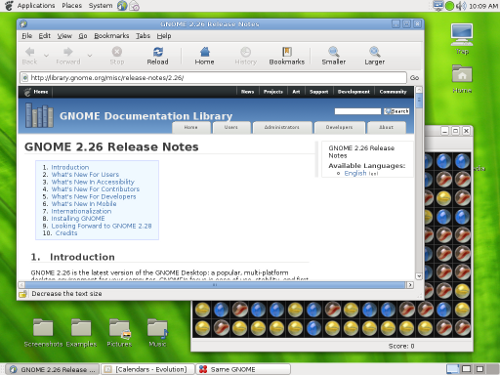 Lets face it, the Average person isn't going to care about the basic look, as long as there is something familiar about it. If the User interface is not familiar, then they won't want it. For example if someone has been using windows for the last 10 years, the odds of them trying a MAC is very slim because the interface is radically different, the same can be said about the default setup for the average Gnome interface (see right, image source URL is This link here also good info on that site as well if you are interested.) To the average Windows or Mac user this interface will likely be a touch confusing to start with. Who really wants to deal with something new when they have been working with something functional for the longest time?
Now interesting to note here, this is only the default setup of Gnome. it does not have to look like this. However I doubt most people that right out of the gate would know how to change this even if the nice people that have been working on the Gnome project for years now have made it exceedingly easy to do. A right click hear, a theme change there, and you could have an interface that would look remarkably like your favorite Operating System.
But enough about interface, lets move on to programs. If say for instance a new game just came out and you want to play it. Well more than likely you would be out of luck because Linux does not have the ability (by default once again) to run Other OS's software. This is mainly due to the fact that most programs for windows, unless they are originally linux programs, are not going to run by default or have a way to install them. There are a few exceptions such as games from ID software (makers of the Doom and Quake series') but as a general rule the linux installer is not provided by default and you have to go to their website after buying the game to get the linux installer. However to return to the original idea here. Say you want Microsoft Office 2007 or maybe some tax program. You will find that none of them mention linux as a requirement. This is because only a small percentage of the world uses linux based OSes. So the companies say "Why bother with linux?" and they leave that support out. If you stick the disk in there and try to install anyway you will find that it won't work unless the linux distribution you installed includes the WINE project, but we'll cover that some other time.
So what do you do now that you have a system that can't use Microsoft office? Well interesting to note, most Linux Distributions come with an either basic office programs (word processor, spreadsheet) or will have an entire office suite. Most of the time these programs will come with some sort of support for the Microsoft office file formats so that someone that is using it won't be completely lost. A reasonable example of a distribution that has a full office suite would be Ubuntu, which comes with OpenOffice.org. Not a bad program if I do say so myself. It does just about everything you would expect from a regular Microsoft office and a little more. But... we are left with one small question... is it user friendly? Well in my opinion I say yes it is, if you are used to the classic setup and not the more "modern" ribbon style. Some things are labeled a little different but it is an easier switch than trying to figure out some wacky new setup.
Connecting to the internet in a Linux distro is usually just as easy as it is in windows if not easier. a right click here and a left click and you are usually connected to a wireless network in no time. Of course there are those times when you have a computer that doesn't have a fully supported piece of hardware, which causes you to not be able to use it. This has vastly improved over the years, but there are still pieces of hardware out there that lack support. In some cases a wireless card may not be supported and the ability to connect to the internet will be stunted by this. What causes this? Usually really new hardware that nobody has had a chance to deal with yet.
Community support... that is something that is touted as being the saving grace of Linux and other Open Source programs. Someone in their basement with some free time writes a line of code to fix an issue and submits it to the community and it is reviewed before being sent out. That is drastically different than closed source programs which all programming is done in house. A community project has an advantage in that there are millions of average people out there that could help, where an in house program only has a team of people to make it. Is that a good thing? It can mean that a bug that is found can be squashed quickly, but there is the opening for someone poisoning the community pool with malware, or at least that's what they would want you to think, that is where the community shines. If it is discovered that something does something malicious, it will be removed quickly. for in house programming, if one of those programmers decided to stick a bit of malicious code into something they are working on, it can likely get sent out with that malicious code on it. Is that likely to happen? Maybe, but the odds of someone risking their job for a silly prank is pretty slim.
Since I mentioned Malicious code, which can include viruses, spyware, adware, worms, trojans, etc. for most of that stuff if you used linux you would be safe from that. However if you were to think about it from an evil hacker's standpoint. "I'm going to write a virus for windows just because more people use it." Do you see where I'm going with this? it gives far more targets to shoot for. Linux in itself is normally safer by design. This dealing with how the system itself is set up. However, any hacker that is worth their salt would know how to hit anything with malicious code. The reason that most don't bother with linux (or MAC for that matter) is because they don't stand to hit enough targets with their code. That doesn't mean you won't see a virus out there that is designed to destroy a linux system (or a MAC once again). Its just highly unlikely because there are far more windows computers out there and many businesses use windows as well.
I will stop there for the moment... Is Linux ready for mainstream? many of the "community" would say yes. but I say that it would take a little more than sticking with the defaults to make a good system for the average user. Are some open source projects however, ready for mainstream... programs such as openoffice.org, Mozilla's own Firefox and Thunderbird. Many people use some of these programs every day. Especially Mozilla Firefox. So I would say in my opinion, that some Open source projects can be mainstream. but Linux, though stable, is not entirely ready.
tl;dr: Linux not ready but some open source projects are.
See you next time. figuratively speaking of course.
Links to things discussed and an extra for those that wish to see a little more.
www.ubuntu.com
www.mozilla.com
www.openoffice.org
www.fedoraproject.org

No comments:
Post a Comment